Conservation Research
Conservation Banking Buyers and Spatial Dynamics in California
This research examines conservation banking in California as a form of market-based environmental mitigation. Using transaction-level data, I analyze who purchases conservation credits, where transactions occur, and how demand varies across regions and sectors.
Why This Matters
Existing research explains how conservation banks are created and valued, but offers less insight into who purchases credits and how demand is distributed across regions and industries. Understanding these patterns is critical for evaluating how effectively conservation banking balances development with ecological protection.
Research Questions
- Who is purchasing conservation credits?
- What types of entities are driving demand?
- How does demand vary across regions?
Data & Methods
This project uses data from the U.S. Army Corps of Engineers’ Regulatory In-Lieu Fee and Bank Information Tracking System (RIBITS). Transactions were categorized by sector and mapped across six California regions using GIS tools.
The analysis combines:
- Sector classification of buyers
- Regional transaction mapping
- Credit volume comparisons
Spatial Patterns and Market Activity
Preliminary Findings
Who is purchasing conservation credits?
The data show that credit purchases are concentrated among a limited number of sectors, with property development and infrastructure-related projects accounting for a significant share of transactions. This suggests that conservation banking demand is closely tied to land conversion and development activity.
What types of entities are driving demand?
Buyers can be broadly categorized into private developers, public agencies, and infrastructure-related entities. Private sector actors appear to dominate overall demand, while public and quasi-public entities contribute to specific regional patterns depending on project type.
How does demand vary across regions?
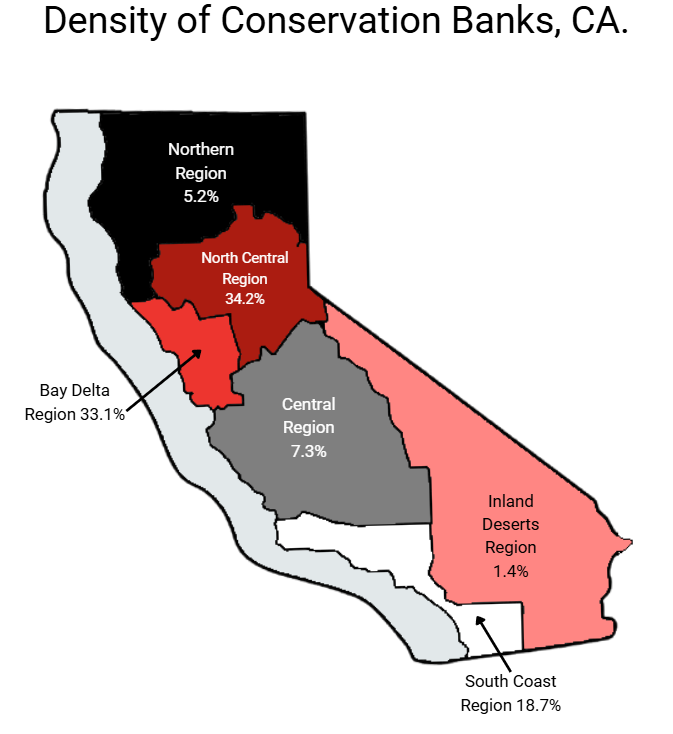
Demand is unevenly distributed across California, with higher transaction volume in regions experiencing significant urban and agricultural expansion. These patterns indicate that conservation banking activity is closely linked to development pressure and land-use change.
Early-Stage Takeaways
Conservation banking demand is not evenly distributed, but instead reflects patterns of development, regulation, and land-use pressure. Understanding these dynamics provides insight into how environmental mitigation operates in practice and where policy adjustments may be needed.